
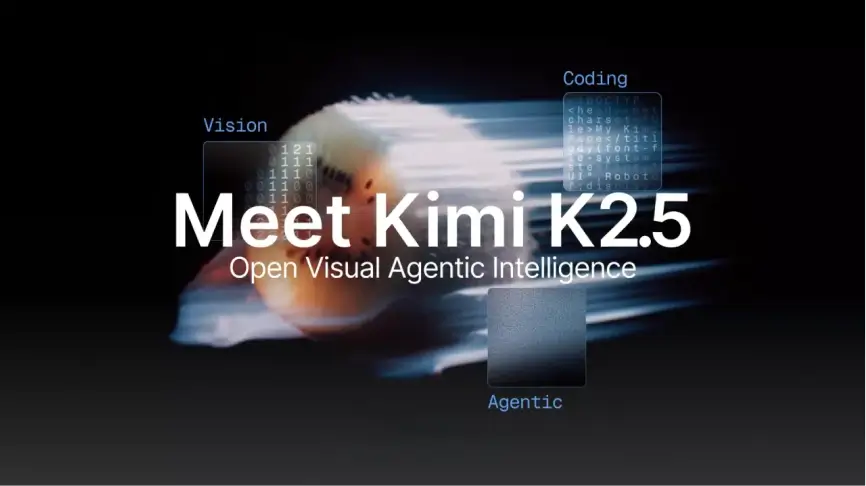
Kimi K2.5 is the latest open-source artificial intelligence model released by Moonshot AI in January 2026. It represents a major leap in accessible AI technology by combining native support for text, images, and video with advanced agent-based workflows. This model builds on previous versions of Kimi, extending capabilities that rival (and in some benchmarks surpass) proprietary models from OpenAI, Anthropic, and Google.
Unlike many open weights models that add vision after the fact, Kimi K2.5 was trained from scratch on mixed visual and textual data, giving it deep multimodal understanding at its core. Additionally, it introduces a novel Agent Swarm System that orchestrates up to 100 autonomous sub-agents to work on complex tasks in parallel, drastically cutting execution times and expanding practical automation capabilities.
Key Features of Kimi K2.5
Kimi K2.5 processes text, image, and video inputs seamlessly in one model. This enables tasks such as visual debugging of interfaces, summarizing video content, understanding diagrams, and linking text descriptions to visual cues.
Agent Swarm Orchestration:
Its standout innovation is the agent swarm, where up to 100 sub-agents can run in parallel, managing tool calls, workflows, and multi-step tasks more efficiently than traditional single-agent pipelines. This enables a reported 4.5× improvement in task completion speed for complex work.
Performance and Benchmarks:
Independent evaluations place Kimi K2.5 competitive with leading proprietary models across many benchmarks. It scores well on visual reasoning and agent-based tasks and performs strongly in code and multimodal workloads, even beating or matching models like GPT-5.2, Claude Opus 4.5, and Gemini 3 Pro in certain AI agent performance measures.
Open-Source Accessibility:
Unlike many frontier AIs that require paid APIs, Kimi K2.5’s weights are openly available under permissive licensing. Developers can run the model locally or integrate it into private infrastructure without ongoing per-token fees, lowering barriers for experimentation, integration, and customization.
Use Cases and Applications of Kimi K2.5
Kimi K2.5’s versatility spans industries:- Software Development: It understands both natural language and visual elements, allowing it to generate, debug, and reason about code from mixed media prompts.
- Content Creation: Writers and creators can generate complex documents or presentations from minimal input, integrating text with visual references.
- Research and Analysis: Its long-context memory and deep reasoning help in summarizing academic or technical material and uncovering insights from large datasets.
- Enterprise Automation: With agent orchestrations, teams can automate multi-part workflows such as data ingestion, report generation, and task sequencing.
Challenges and Limitations
Despite its strengths, Kimi K2.5 has high hardware requirements for full-scale local deployment, often demanding large amounts of VRAM and compute power. Quantized versions aim to alleviate this, but widespread consumer-grade usage still faces barriers.
Why It Matters
Kimi K2.5 signifies a shift in the AI landscape where frontier performance is no longer exclusive to closed proprietary models. Its open-source nature accelerates innovation and democratizes access to powerful AI, allowing developers, researchers, and organizations worldwide to build custom solutions without restrictive pricing models.
Comparing AI Leaders: ChatGPT, Claude, Gemini, and Kimi K2.5
Below is a comparison table focusing on core capabilities, strengths, and general differentiators.
| Feature / Model | Kimi K2.5 | ChatGPT (GPT-5.2) | Claude Opus 4.5 | Google Gemini 3 Pro |
|---|---|---|---|---|
| Developer | Moonshot AI | OpenAI | Anthropic | Google DeepMind |
| Open-Source | Yes | No | No | No |
| Multimodality | Native text, image, video | Text + images (with extensions) | Text + images | Native text, image, audio, video |
| Agent Workflows | Agent Swarm up to 100 agents | Tool-based agents | Tool-based agents | Tool-based agents |
| Context Window (approx) | 256K tokens | ~400K tokens | ~200K tokens (larger beta available) | ~1M tokens |
| Benchmark Strengths | Agentic tasks, cost/performance | Reasoning, tools, productivity | Coding, logic and step-wise tasks | Long context and multimodal reasoning |
| Best For | Custom deployment, open-source workflows | General AI tasks, reasoning, productivity | Code, structured tasks, enterprise agents | Multimodal understanding, Google ecosystem |
| Cost Model | Free or self-host | Subscription / pay per use | Subscription / pay per use | Subscription / pay per use |
| Availability | API, self-host | API, ChatGPT app | API, Claude app | API, Gemini app |
Notes on Models
ChatGPT (GPT-5.2) emphasizes robust reasoning, productivity help, and broad general use, supporting complex workflows and tool integrations.
Claude Opus 4.5 is often highlighted for deep contextual reasoning and strong coding performance within a safety-aligned framework.
Gemini 3 Pro stands out for massive context handling and multimodal processing, especially when combining text, image, video, and audio tasks.
Kimi K2.5 provides a unique open-source alternative with native multimodality and parallel agent orchestration that can outperform others on certain agentic and visual workflows while offering deployment flexibility.
Kimi K2.5 is not just another AI model; it signals an important milestone in open-source frontier AI capability. Its native support for multimodal inputs, agent swarm orchestration, and competitive benchmark performance make it a compelling choice for developers and organizations seeking performance without proprietary lock-in. When combined with the strengths of commercial models like ChatGPT, Claude, and Gemini, the AI ecosystem becomes richer and more adaptable for diverse use cases in 2026.